Study status: methodology draft — no test results are available. This report should be published as original research only after real iPhone measurements are collected. It would be misleading to present estimated or invented launch times, battery consumption, crash rates or rankings as findings.
Research question: How do verified, legally available iPhone casino apps compare on launch time, game-loading time, stability, power consumption and accessibility under controlled conditions?
Tested devices, iOS versions and methodology
The test design must define the market and exact set of authorized operators before any measurement. Use comparable iPhones where possible, document device health and record the build of iOS and each app. Recheck licensing and storefront availability on the test date. A comparison of gambling apps from different jurisdictions is not valid unless the location context is explicit.
Network conditions and test sample
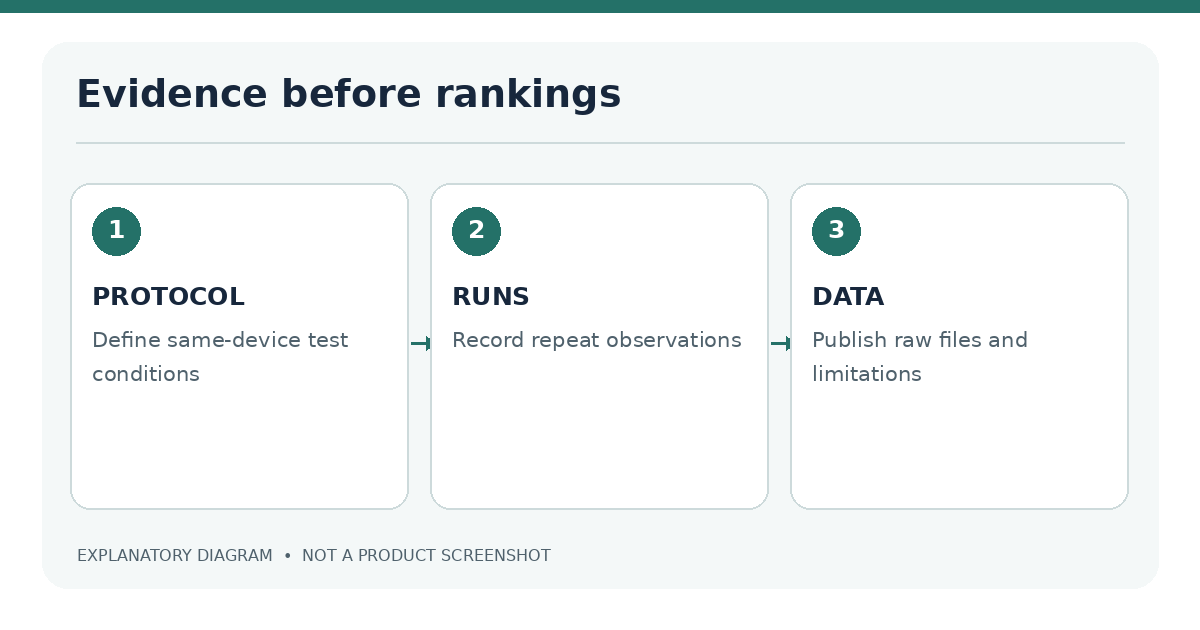
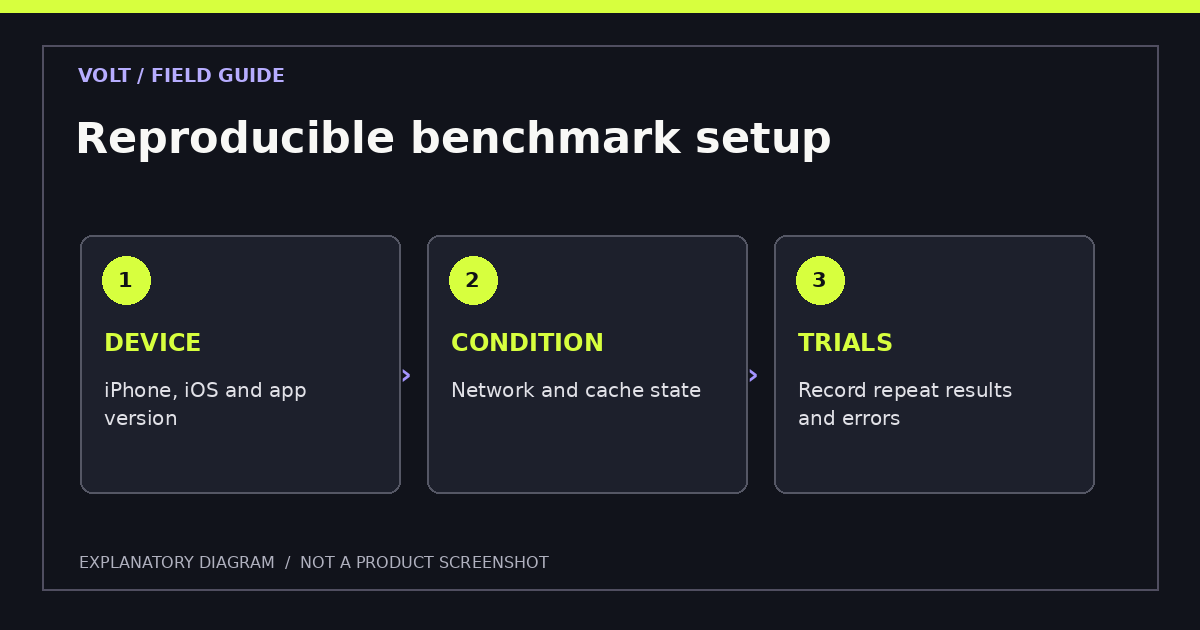
Specify whether tests use Wi-Fi or cellular data, describe connection quality, and avoid comparing one operator on fast Wi-Fi with another on a congested mobile network. Use a consistent screen brightness, background-app state and device temperature policy. Run each task multiple times and record the raw measurements, not only a favorable screenshot.
| Required study field | Value before tests |
|---|---|
| Test market | Not selected |
| iPhone model(s) | Not recorded |
| iOS build | Not recorded |
| Tested casino app versions | Not recorded |
| Network conditions | Not recorded |
| Runs per task | Protocol to be approved |
| Test dates | Not scheduled |
This article describes a test protocol, not completed results. A reliable benchmark cannot be built from screenshots of marketing material or assumptions about an app's technical architecture. Each candidate service first requires legal authorization in the test location and a verified official download or domain. The study then needs real iPhones, recorded software versions and repeatable tasks. If the editorial team has no lawful access to the service, it should not claim to have tested its live real-money features.
The test record should identify the exact iPhone model, iOS build, available storage, battery condition, connection type, app version, date and location at an appropriate level of precision. Capturing an exact personal street address is unnecessary for publication; the relevant jurisdiction is sufficient. A test conducted on Wi-Fi should not be combined with a cellular result to produce one unexplained average. Device temperature, charging state, background applications and cached data can all affect repeatability.
Each task must have clear start and end events. For an app cold launch, define whether timing starts when the icon is tapped and ends when the main interface can accept normal input. For a website, define whether timing begins at navigation and ends at a usable page. Measure a second route separately if it is a game launch or account-screen navigation. Do not treat a loading animation as proof that the interface is already usable.
| Measurement | Start condition | End condition | Reporting caveat |
|---|---|---|---|
| App cold start | App fully closed; icon tapped | Main interface usable | Not the same as a warm reopen |
| Safari first load | Fresh page navigation | Main page usable | Browser and network cache vary |
| Repeat launch | After standardized pause | Same defined usable state | Show median and range |
| Game start | Game selected from catalogue | Controls available, if legally testable | Game/provider differences matter |
| Session recovery | Standard interruption introduced | Interface usable again | Record errors and account state |
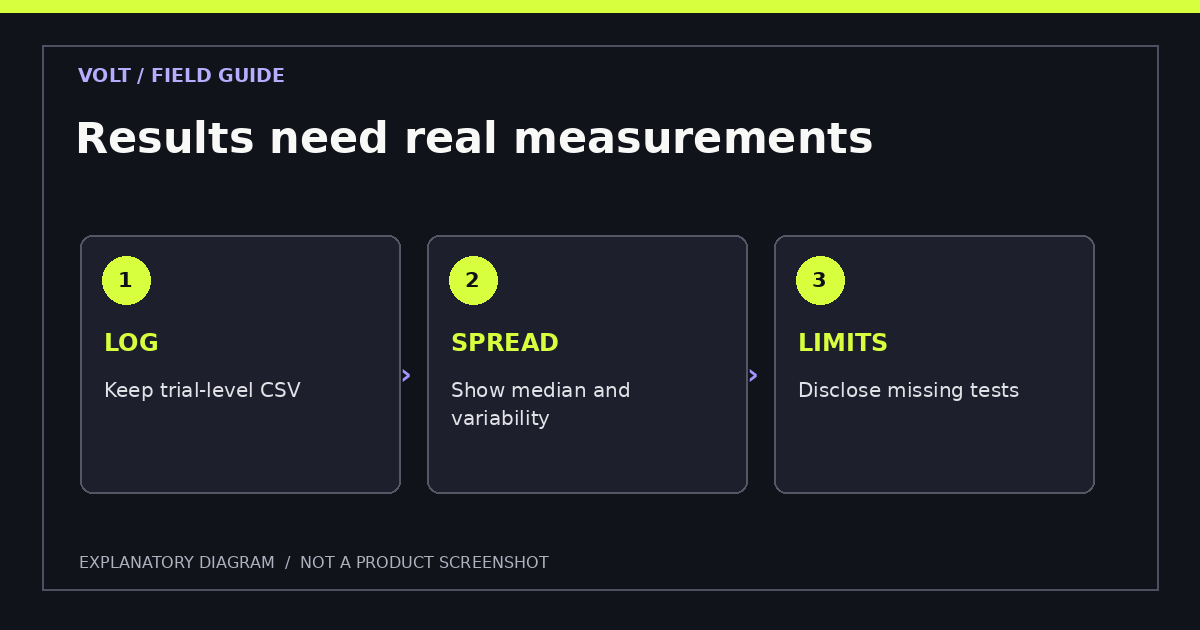
Repeat each condition enough times to make outliers visible, and preserve raw measurements rather than publishing only a single score. The number of repeats should be chosen and documented before results are collected. Include failed launches in the failure rate; silently dropping them would make reliability appear better than it was.
App cold launch and loading time results
A cold launch should be defined consistently, such as time from tapping the icon to the first usable screen after the app has been fully closed according to the protocol. A game-loading metric needs a similarly precise start and end event. Network and account-related steps should be separated when possible.
Reproducible app-versus-app measurements
| App identifier | Cold launch median | Game load median | Sample size | Status |
|---|---|---|---|---|
| Operator A | — | — | — | Not tested |
| Operator B | — | — | — | Not tested |
| Operator C | — | — | — | Not tested |
No application should be named, scored or ranked in this table until all legal access and measurements are verified. A single observation cannot support a claim that one app is fastest.
No numerical results appear in this release because no original device measurements were provided. This is a necessary boundary, not an empty promise. A table headed "results" must contain real values and their test context or be marked as awaiting measurement. A chart cannot show an invented estimate and remain an editorial benchmark.
When data becomes available, summarize each test with a sample count, median, observed range and number of failures. A median is often easier to interpret than a single selected fast launch, but it does not eliminate the need to display variability. If a service fails to launch in several attempts, that is itself a meaningful observation and should be reported with the error state. Do not attribute the failure to a particular publisher without enough evidence to distinguish server, network, device and authorization issues.
A comparison may also need to separate the same operator's app and browser experience. If one route requires an update while the other is served from the web, document that operational difference. If the app is unavailable in the legitimate test region, record it as not eligible for that comparison rather than using a different storefront or falsified location to obtain a measurement.
Stability, memory and battery observations
Track crashes and recoverable errors separately. Record any forced logouts, failed game loads or permission prompts. Battery consumption should be measured over consistent periods with comparable screen brightness, background conditions and connection type. If precise energy diagnostics are unavailable, use a clearly labelled observation instead of implying laboratory-grade precision.
Memory usage can change with iOS and app behavior. Report the measurement technique and its limitations. Avoid comparing raw values collected using incompatible tools or operating-system versions.
Charts and downloadable raw data
When the tests are complete, publish charts that show a central estimate and variability, rather than a single winning bar. Provide a downloadable CSV with each run, timestamps and test conditions. Readers and automated agents should be able to trace each figure to a data row.
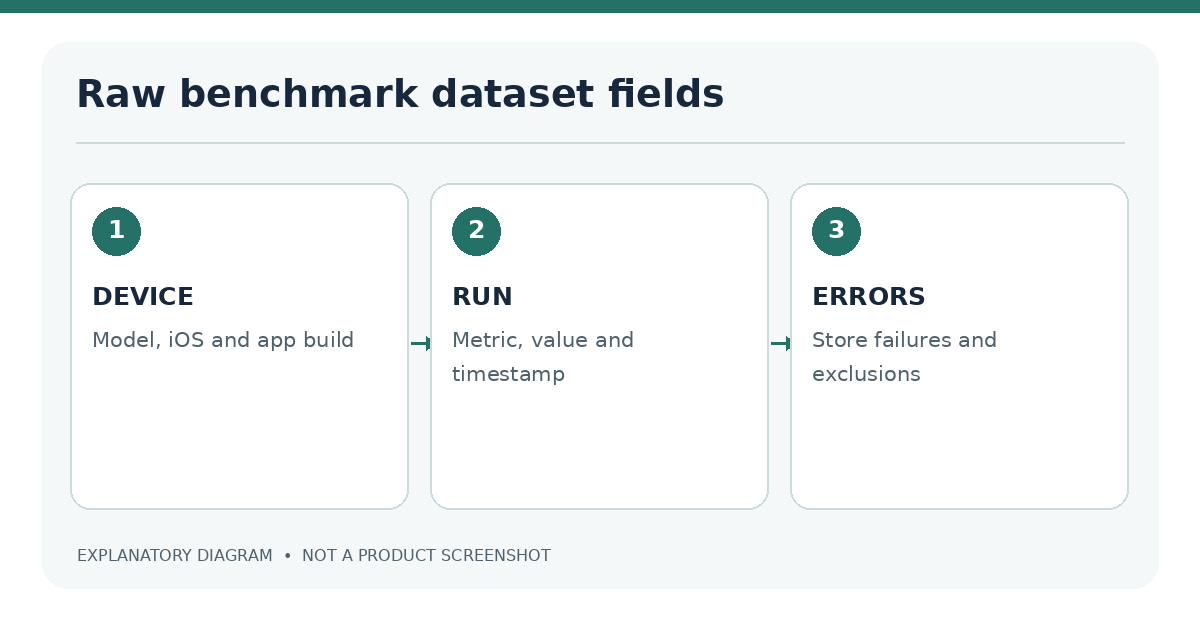
Suggested dataset schema:
| Column | Meaning |
|---|---|
| test_id | Unique run identifier |
| operator_id | Verified anonymous or named operator |
| device_model | iPhone used |
| ios_version | Exact version |
| app_version | App build |
| network_type | Wi-Fi or cellular |
| metric | Cold launch, game load, etc. |
| value_ms | Timed result, if applicable |
| error_code | Recorded failure, if any |
| test_datetime | Timestamp |
How to reproduce the tests
- Publish the final protocol before selecting a winner.
- Record operator eligibility, test device and app versions.
- Define start/end events for every metric.
- Capture repeated runs under matched conditions.
- Exclude or annotate invalid runs using predeclared rules.
- Provide raw observations, summary calculations and limitations.
- Recheck licensing and access when the report is updated.
The raw dataset should have one row per trial, not one row per operator. Suggested fields are test identifier, lawful market, iPhone model, iOS build, app or browser version, task name, repetition number, start timestamp, elapsed milliseconds, outcome, and relevant conditions. Before publication, remove account identifiers, personal locations and private network information. A downloadable CSV should match every chart in the article.
Graphs should make uncertainty visible. Avoid a single large bar whose difference is smaller than the ordinary variation across trials. Consider showing a median plus the spread of repeated observations, and disclose missing results. If a benchmark compares devices with different hardware generations, separate those results instead of framing them as an app quality ranking. Any future "fastest" claim must specify the dataset and conditions to which it applies.
The revision protocol matters as much as the first test. A major iOS update, new app release or change to the website can invalidate an older observation. Record the revision date and preserve earlier raw data so readers can see whether methods changed. A claim that performance improved requires comparable before-and-after measurements, not an assumption that a newer release is necessarily faster.
Study limitations and update schedule
A study of a few device models cannot establish performance on every supported iPhone. Network and operator servers can change, and casino products differ in catalogue and interfaces. Legal access requirements can also limit which products may be directly compared in a given market.
Will this report rank the fastest casino app? Only if valid repeated measurements and clearly defined comparison criteria support that claim.
Can an app-versus-Safari guide replace these tests? No. A two-format comparison answers a different question from a quantitative multi-operator benchmark. See app versus browser.
When will test numbers be added? Only after real measurements are available. No data collection or publication schedule is represented as completed here.
A benchmark should report its limitations alongside the measurements rather than hiding them in a small note. A small number of devices may not represent older iPhones, different cellular carriers or accessibility configurations. A public login screen may behave differently from a game screen reached after verification. Testing at one time of day cannot establish average server performance throughout the week.
When access to a live casino is legally unavailable, the study must omit that service or restrict itself to genuinely public, permitted interfaces. It should not use made-up performance numbers or an unauthorized account. An update schedule can be based on meaningful changes such as an iOS release, an app revision or new measured evidence. Each revision should link to the underlying data and clearly identify changes to the test method.
Further reading: A method-only benchmark should be read beside app versus browser comparisons, iOS compatibility evidence and app crash diagnostics.
Sources for the study protocol
- Apple App Review Guidelines — app eligibility and distribution rules.
- Apple: Get apps in the App Store — identifying current product versions and requirements.
Last methodology review: 18 November 2026. Do not publish this page under a “Our Test Results” claim until real results and raw data exist.