Quick answer: Legal real-money iPhone casino apps are available only in US markets that authorize that form of online gambling. As of 18 November 2026, established live online casino markets include Connecticut, Delaware, Michigan, New Jersey, Pennsylvania, Rhode Island and West Virginia. Maine enacted an internet-gaming framework in 2026, but legislation and rulemaking should not be confused with a live, approved operator launch. Always check the relevant state regulator before installing or depositing.
Online casinos, online poker, sports wagering, free-play apps and sweepstakes products are not the same legal category. This page concerns full real-money casino products unless a section says otherwise.
State-by-state real-money online casino availability
The United States does not issue one nationwide licence covering all iPhone casino apps. State agencies decide which operators and games may be offered. A company approved in New Jersey is not automatically permitted to accept online casino wagers in another state.
| State | November 2026 status for real-money online casino | Where to confirm |
|---|---|---|
| Connecticut | Established live market | Connecticut gaming regulator |
| Delaware | Established live market | Delaware Lottery / responsible authority |
| Michigan | Established live market | Michigan Gaming Control Board |
| New Jersey | Established live market | NJ Division of Gaming Enforcement |
| Pennsylvania | Established live market | Pennsylvania Gaming Control Board |
| Rhode Island | Established live market | Rhode Island regulator/operator approvals |
| West Virginia | Established live market | West Virginia Lottery |
| Maine | Legal framework enacted; live operator status requires separate check | Maine Gambling Control Unit |
| Other states | Do not assume full online casinos are authorized | Specific state regulator |
Check current approval and official regulator sources
Michigan's Gaming Control Board publishes official information on licensed internet-gaming providers. New Jersey publishes authorized internet gaming sites. Maine's Gambling Control Unit has official internet gaming rulemaking and application pages. Use those sources rather than relying on a national comparison page that may group legal authorization and actual market launch together.
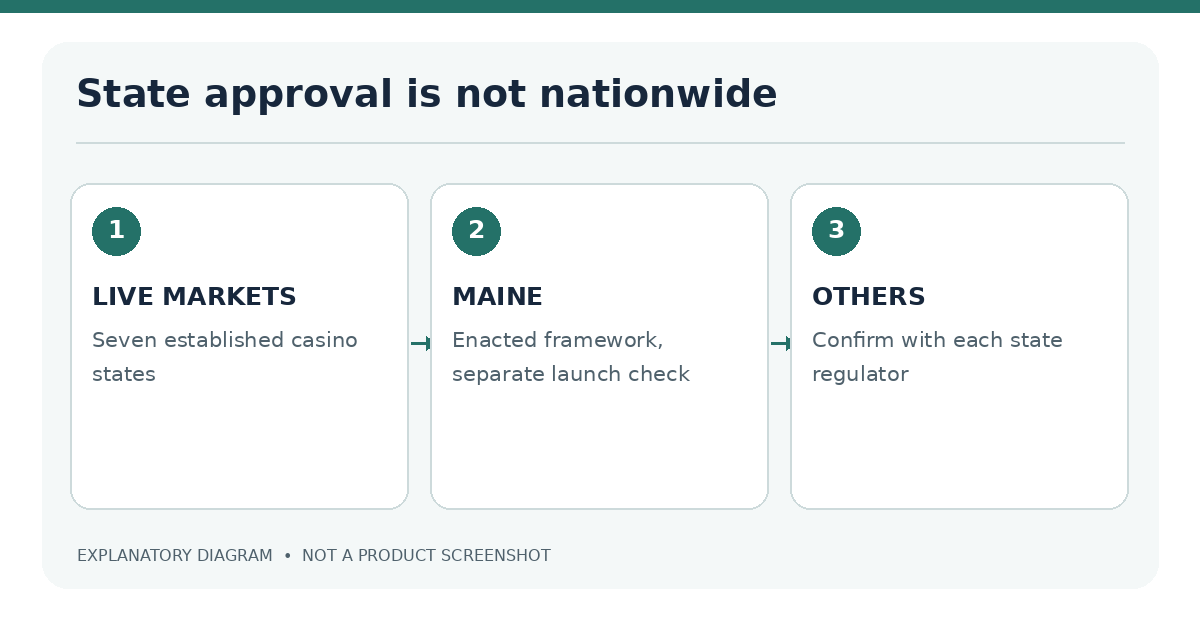
This table is an editorial snapshot, not a guarantee that a named brand is approved today. State licensing and product availability can change. The status of Maine is particularly important: an enacted law does not itself establish that a consumer-facing casino app has launched and been approved.
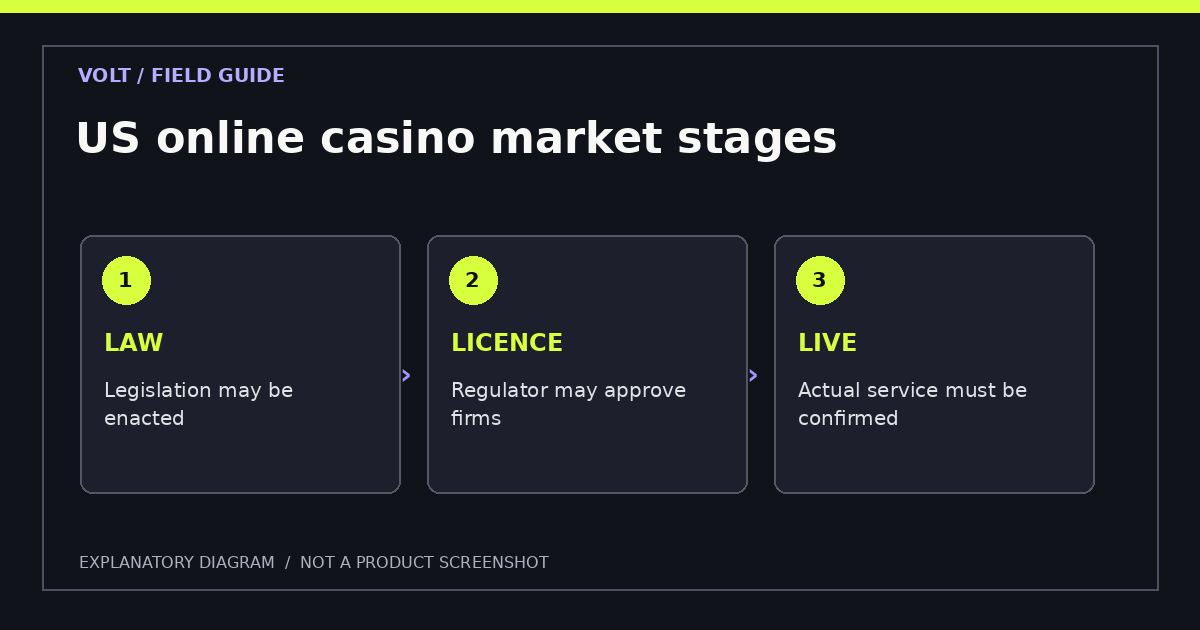
State status must be reported in stages. In the United States, online casino law and online sports betting law often follow different tracks. A state can authorize sports wagering without permitting a conventional real-money internet casino. Another state may pass a law authorizing casino games but still be writing rules or granting licenses before the first regulated services open. The phrases "legalized", "licensed" and "live" should be given their own meanings in any state table.
This distinction is particularly important for Maine in 2026. The state enacted an online casino framework involving Wabanaki Nations, but a new framework is not automatically equivalent to a list of currently operating, approved sites. Readers need to consult the relevant state authority for the launch status and operators actually allowed to provide service on the date of use. Do not add a brand to a Maine ranking solely because it announced a partnership or possible launch.
For states with operational regulated internet casino markets, check the official state regulator's operator information. New Jersey publishes authorized internet gaming sites. Michigan, Pennsylvania, Connecticut, Delaware, West Virginia and Rhode Island have their own regulatory structures and authorized services. A concise national guide can identify those jurisdictions as starting points, but a live operator list must still be checked locally. Nevada also requires product-specific caution: lawful remote poker or other wagering should not be collapsed into a general claim that full online casino slot sites are available there.
| Status phrase | Meaning | What an iPhone user should check |
|---|---|---|
| Legislation proposed | A change has been introduced or discussed | No live permission should be inferred |
| Law enacted | A statutory framework exists | Rules, effective dates and product scope |
| Regulator licensing | Applications or authorizations may be in process | Actual approved entities and activities |
| Market live | Approved services may currently operate | Official operator/domain list and device access |
| Service available to this player | The particular account and location are eligible | Age, precise physical position and current terms |
A nationwide marketing list can therefore be less useful than one carefully verified state page. The correct comparison is not simply which brands have the largest logos; it is which operators hold the proper permissions in the precise place where the person is located, and what access method they currently provide there.
Native iOS apps versus browser access where legal
In an approved state, an operator may offer a native app or mobile website. Apple requires gambling apps to have appropriate licensing and location restrictions. The exact available interface may depend on the App Store storefront, your iPhone's iOS version and operator design.
| Question | Native app | Safari |
|---|---|---|
| Where to check authenticity | Official App Store developer | Official regulator-linked domain |
| Device requirement | Listed supported iOS version | Browser/site compatibility |
| State restriction | Applies | Applies |
| Identity checks | Operator/regulator controls | Same account obligations |
| Game catalogue | Must be verified | Must be verified |
A browser bookmark is not an alternate licence route. If real-money casino play is unavailable in your state, installing a different app or opening Safari does not make it lawful. The app-versus-browser guide handles technical differences in depth.
Licensing and physical location requirements
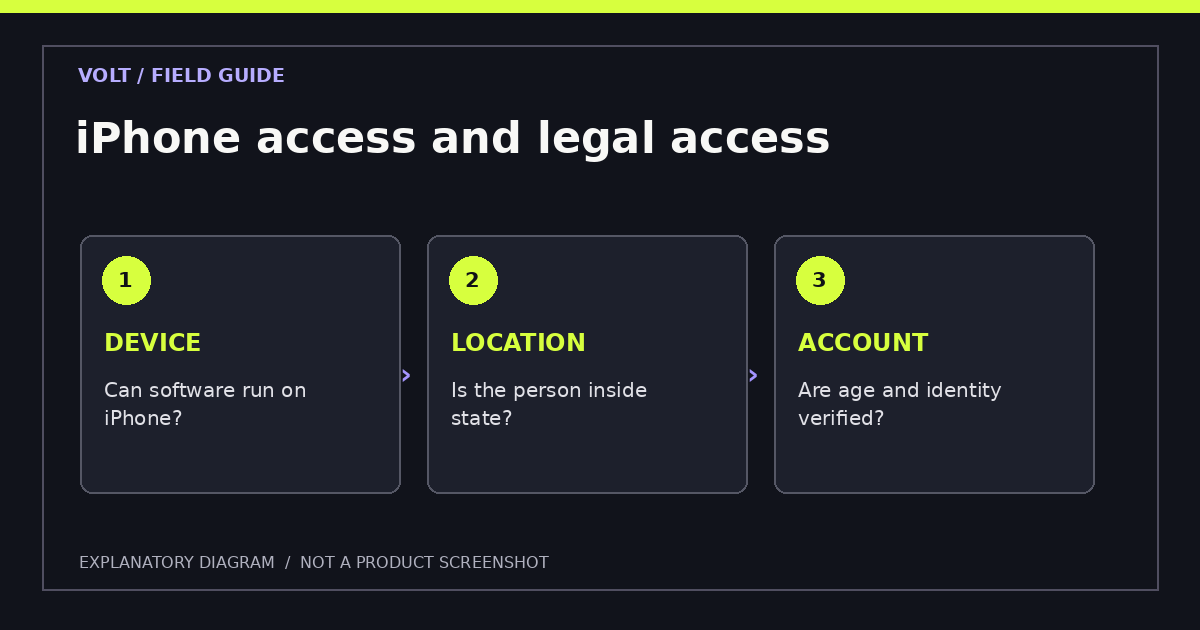
Operators may verify age, identity and physical location before accepting real-money play. The relevant legal presence requirement can differ from an account's permanent address. New Jersey, for instance, has location requirements for internet gaming participation. A traveler should not presume that home-state residency gives access outside the approved territory.
Why your physical location matters
iPhones use location signals and permissions that may support regulatory checks. Being connected to a local Wi-Fi network is not sufficient proof of lawful eligibility. Altering or spoofing the phone's location does not change where the person is and may conflict with law and account terms.
For a technical explanation without bypass instructions, see casino app location verification on iPhone. For identity checks and private documents, use the iPhone KYC guide.
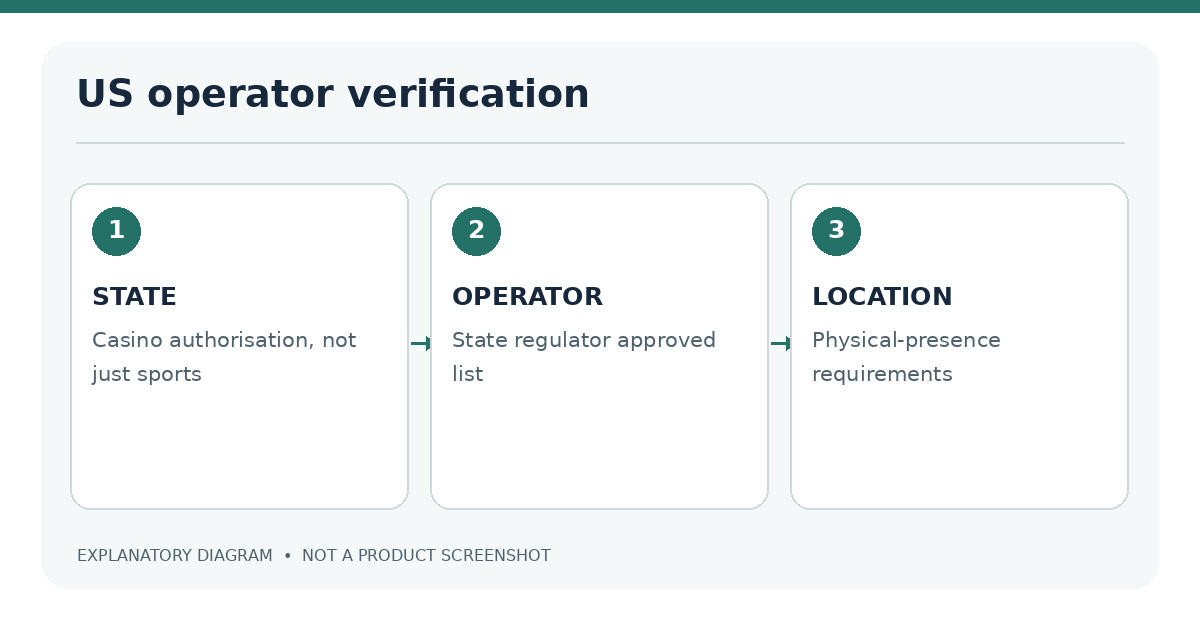
A US state licensing check begins with the regulator rather than the App Store. A familiar app name may appear in several state storefronts or use related branding across different services. That does not mean the underlying online casino product is lawful in every state. Confirm the activity type, authorized internet gaming domain and operator identity for the actual state under review.
Physical location may be checked when a user attempts to access a regulated service. A resident visiting another state should not assume that their home address lets them wager remotely from anywhere. Similarly, being physically within a state does not automatically make a person eligible; age, identity and account conditions also apply. An account screen displaying a state flag is not a substitute for legal verification.
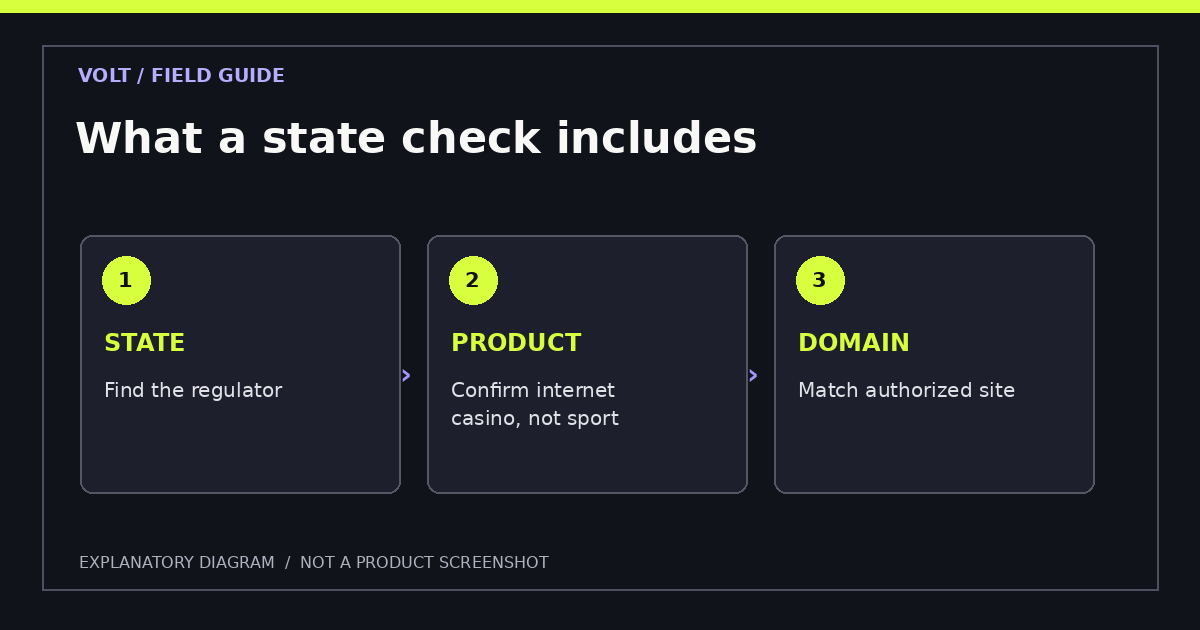
How to research a state systematically: identify the state gaming regulator; locate its official list of internet gaming operators or permits; compare the registered legal entity and the public domain; then inspect the actual app publisher or web route. Next, check the operator's account and identity requirements. If any of those steps produces conflicting information, stop and seek clarification from an official source. The national article should link to a local guide only when it has useful market-specific information—not create near-identical thin pages for all 50 states.
App compatibility and legal eligibility are separate dimensions. One iPhone model may meet a service's technical requirements but be outside its permitted area; another may be inside the state but running unsupported software. Editorial comparison tables should represent both dimensions independently. Avoid treating a failed location check as an app performance defect.
How social and sweepstakes casinos differ
Social casino games may use virtual credits with no cash redemption. Sweepstakes-style products can have separate promotional currencies, entry conditions and prize rules. Neither category should be mixed with state-licensed real-money casinos in a single ranking or described as universally legal across the United States.
A product available for download is not necessarily lawful for every user or state. Review its official terms and local law. The social versus real-money comparison explains what a currency and redemption check should look like.
National rankings often combine products with fundamentally different legal models. Conventional real-money online casinos accept monetary wagers and operate under applicable casino authorization. Social casino games commonly use virtual currency for entertainment and may sell credit bundles; they should not be presumed to offer cash redemption. Sweepstakes-type promotions may have separate prize, entry and territorial rules, and their treatment can vary by state. These categories should have separate labels and separate legal analysis.
A reader should be able to determine whether money is being wagered, whether a virtual balance can be redeemed, what purchase options exist and which regulator—if any—has authority over the specific product. A broad claim that a social or sweepstakes app is "legal in every state" is not a safe substitute for those checks. Legislation affecting one model can also change more quickly than an App Store listing.
This site does not use an unverified sweepstakes catalogue as a stand-in for a licensed iGaming ranking. For practical differences in virtual credits, purchases and prizes, consult the separate social-versus-real-money explanation.
State guides and verification dates
The first state-specific editorial page in this plan is New Jersey iPhone casino apps. That guide points to the NJ DGE approved-site list and records the operator verification process. Other states should receive their own pages only when there is enough distinctive regulation, local testing and original comparison data to justify them.
Can I use a US online casino app in any state? No. Permissions and location restrictions are state-specific.
Does Maine have fully launched iPhone casinos because it passed a law? Not necessarily. Check the Maine Gambling Control Unit's current licensing and launch notices.
Are sports betting apps the same as casino apps? No. They are often regulated as distinct products.
Does an iPhone app remove location verification? No. The operator may verify physical location during access.
A state page should carry its own verification date because launch status and authorized domains can change independently. At minimum, record the regulator's name, its official source page, the product type permitted, and whether the market has active, authorized internet casino services. Keep announcements, proposed legislation, final rules and operator approvals in separate fields. That structure makes later updates easier and reduces the risk of an out-of-date national summary staying online after a state changes its position.
For jurisdictions that do not permit conventional real-money online casino products, do not substitute an unrelated social game as if it were a licensed casino option. The user intent is different. Social games may be available under other rules, but a state casino guide should say plainly when it cannot establish legal cash-gaming access. For states where internet gaming is live, link to the exact local source rather than a general home page when possible.
What an editorial update should document: the date checked; a description of what changed; links to the regulator or official notice; whether licensed service has actually launched; any changes to permitted activities; and whether an iPhone-specific listing was verified. If an operator leaves a market, remove its unqualified recommendation rather than merely adding a small asterisk. Editorial history is a feature of a trustworthy guide, not a distraction.
Further reading: For a local example, see the New Jersey internet casino guide; also read location verification and real-money versus social casino distinctions.
Sources
- Michigan Gaming Control Board: Legal vs Illegal Gaming
- New Jersey DGE: Authorized sites
- Maine Gambling Control Unit: I-Gaming
- Maine Gambling Control Unit: Rulemaking
- Maine Governor: January 2026 internet gaming announcement
State status checked: 18 November 2026. Reverify regulators before publication; this is not a substitute for state-specific legal advice or current operator approval.